You can’t fasten your own bra. And your doctor told you to wait a year.
We are going to skip the part where a stranger describes your own symptoms back to you. You know them better than we do. So instead — four things that came up again and again in the accounts we read, and that almost nobody outside this ever mentions.
- The pain that arrives out of nowhere in the night, in one hit, several times before morning. The women who live with this call them zingers. If that word already means something to you, you know what kind of page this is.
- The salon. Twice a week. Not for a cut — just to have your hair washed.
- Two in the morning, face down, swearing into the pillow so you don’t wake the house.
- And that you stopped counting this in pain a long time ago and started counting it in months.
Every one of those is a real experience, in the words of the person who lived it. None of it is ours.
Nobody warns you about the bra. They warn you about the pain.
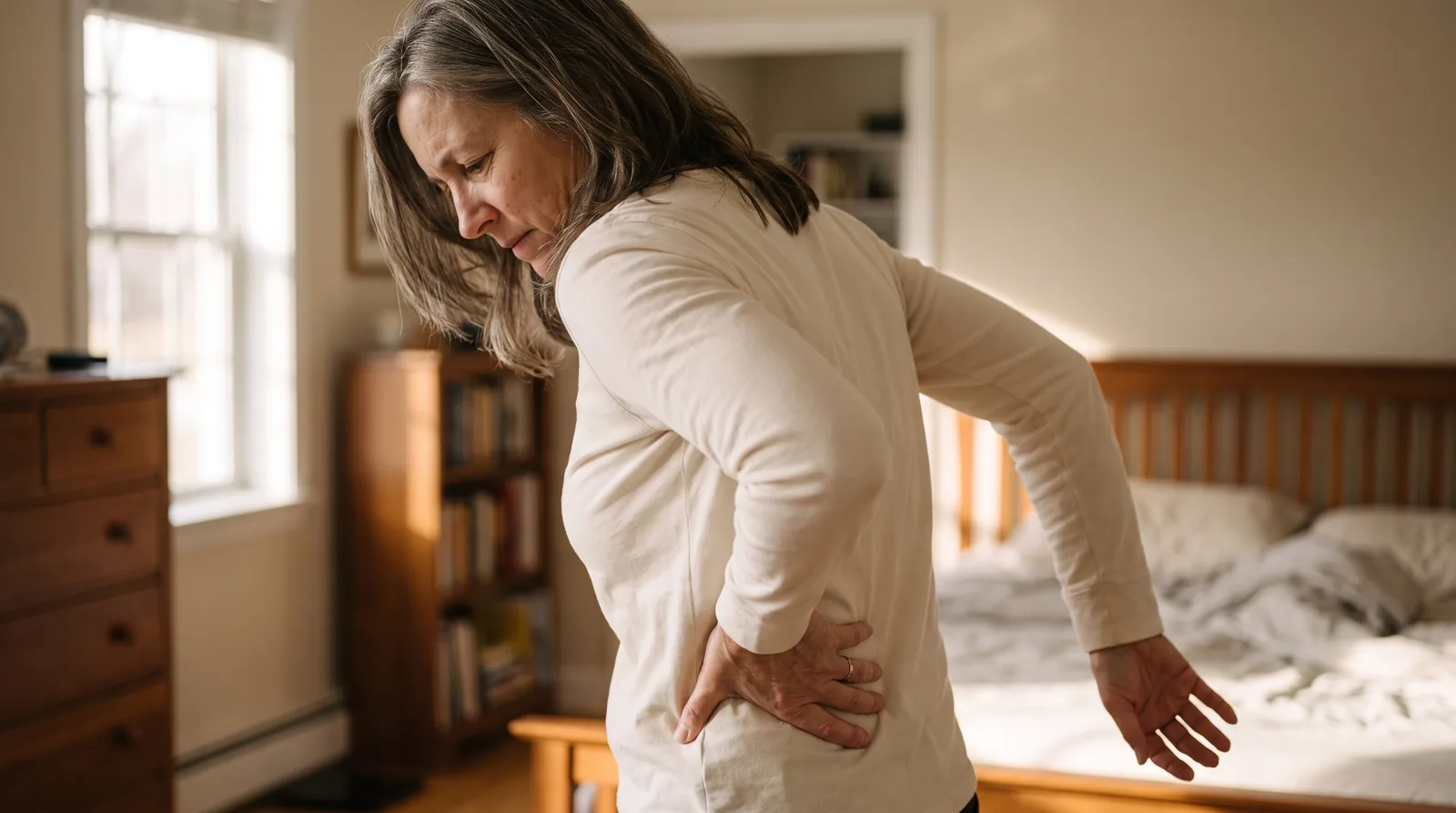
It is not the pain that tells you how bad it has got. It is standing in your own bedroom at seven in the morning, both arms behind your back, and not being able to do the thing you have done every day since you were thirteen.
A woman with this once wrote three words. They got more replies than almost anything else she could have said.
“I fastened my bra today!!”
Twenty-six people wrote back. Most said they had cried when it happened to them too.
Twenty-six women. Crying. Over a hook and eye.
And it is not only the moment. It is the unit of measurement. Another woman, describing the same condition, put it like this:
“I measured the whole thing by the amount of time I wasn’t able to tie my bra. Which was exactly one year.”
Not in pain scores. Not in degrees of movement. In months.
If that sounds ridiculous to you, you do not have this. If it does not sound ridiculous at all, keep reading, because there is something in the research that nobody has told you.
Your scan came back clean. That was supposed to be the good news.
The X-ray showed nothing broken. The MRI, if you got one, showed no tear worth operating on. Your doctor used a word you had to look up in the parking lot: adhesive capsulitis. Frozen shoulder.
And then came the sentence. You have probably heard some version of it more than once:
“It’s self-limiting. It resolves on its own. Give it one to three years.”

Nobody said what you are supposed to do with the nights in between. Nobody said that self-limiting is the word doctors use for conditions that hurt for a very long time and then stop hurting, and that the stopping has very little to do with anything anyone did for you.
You went home and you waited. Because what else is there.
What the next three years look like
There are three phases. Nobody drew you the map.
The clinical reference used to teach this condition breaks it into three stages, and it prints the timings. Read them and find yourself.
Freezing
“An initial, painful phase with predominant pain that is worse at night, with gradually increased restriction of joint movement.”
Frozen
“Stiffness and persisted motion limitation, but with less pain than at the freezing stage.”
Thawing
“The recovery phase, with the gradual return of range of motion.”
The timeline
Three phases. Up to forty-two months.
Months from onset along the bottom. The phases overlap — freezing has not always ended when frozen begins. Source: StatPearls, Adhesive Capsulitis.
What the wait actually is
The phase nobody warns you about is the longest one
The pale block is freezing and frozen together. Everything red is what comes after. Months from onset along the bottom. Source: StatPearls, Adhesive Capsulitis.
And notice which phase has the night written into its definition. Not as a footnote. As the thing that defines it.
So when you lie awake at three in the morning and wonder whether you are being dramatic — you are not. You are in phase one, and the textbook says phase one is the one that hurts at night.
What it actually costs is not the pain. It is the saying no.
Putting your hair up. One woman wrote that she went to a salon twice a week just to have it washed. Reaching for the seatbelt. Shaving under that arm. Putting on a coat, which becomes a two-minute operation you have to plan. Carrying groceries on that side, so you carry everything on the other side, and now that shoulder hurts too.
The zingers do not come once. They come when you turn the wrong way in your sleep, and then again an hour later, and by the third one you are awake until it gets light. One woman wrote that after seven months of that she was signed off work. Not because of her shoulder. Because of what seven months without sleep does to a person.

And the part that is hardest to say out loud: you have become someone who says no. No to the trip. No to the class. No to picking up the grandchild, because what if you cannot hold on.

Eleven months. Fourteen months. Two years. That is what women with this are counting in.
What has already been tried on it
Somebody has already read every trial on this. All of them.
There is an organisation called Cochrane. They do not sell anything. They read every published trial on a treatment and then state, in plain language, how much the evidence is actually worth. Doctors use their reviews to decide what to recommend.
In 2014 they published a review on the treatments used for frozen shoulder. Nineteen trials. And they graded every one.
What the reviewers wrote
- ✕Therapeutic ultrasound — very low quality evidence
- ✕Pulsed electromagnetic field — uncertain
- ✕Continuous short wave diathermy — very low quality evidence
- ✕Iodex phonophoresis — very low quality evidence
- ✕Iontophoresis — very low quality evidence
- ✕TENS — very low quality evidence
- ✓Low-level laser therapy. The only one of the seven the reviewers graded above very low — the best grade awarded anywhere in this review.
What the review found
Seven treatments went into this review. One came out.
Six sat at the bottom. One did not. Cochrane Database of Systematic Reviews, 2014 (PMID 25271097). Six of the seven were graded very low. Low-level laser therapy was the only one the reviewers put above that line — the best grade awarded to any treatment anywhere in this review.
Read that list once more. Some of those are the machines that were wheeled up to your shoulder in the physio room. The ones you drove to twelve times.
SEE WHAT IS INCLUDED —180 nights to decide · free US shipping · 2-year warranty
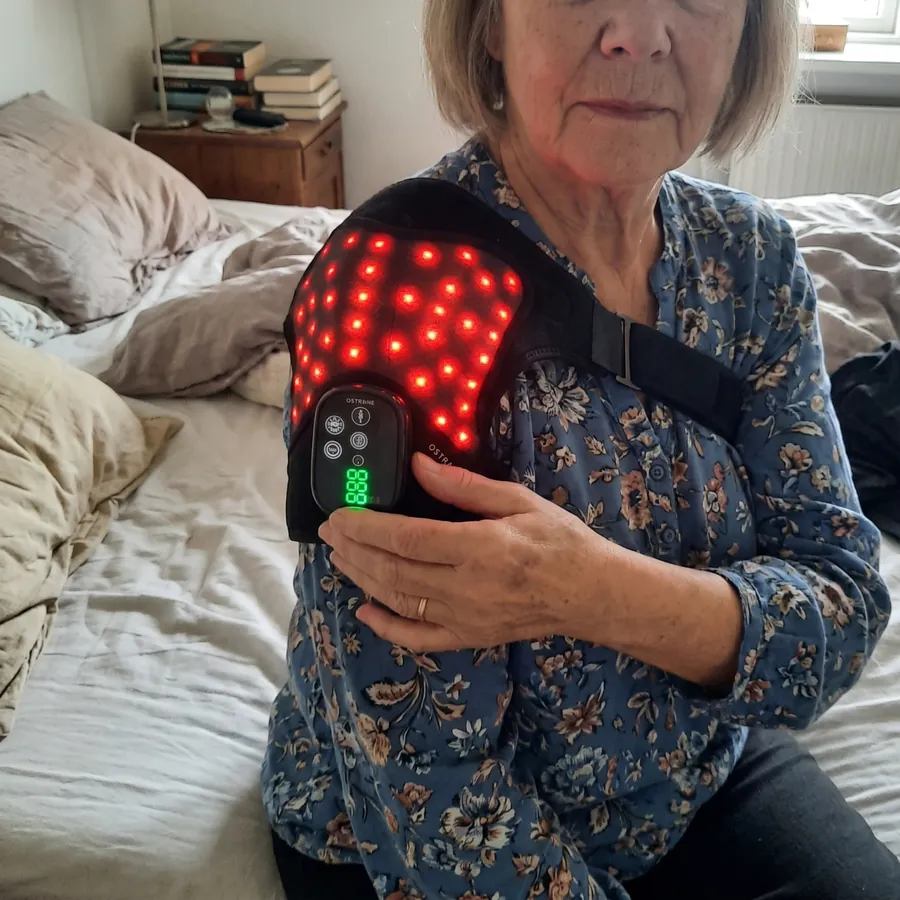
“What I can say is I turned over at 3am last night and did not wake up all the way. That has not happened in years”
Why it lands on women
Four times more women than men. That is not bad luck. That is the pattern.
Who this happens to
Four times as many women as men
Source: StatPearls, Adhesive Capsulitis. That is not bad luck. That is the pattern this condition has always had.
The same reference says it is unlikely below forty, and that above seventy it is usually something else entirely. Which puts the window almost exactly where you are standing.
It also lists the conditions that raise the risk. Two of them are on a great many women’s charts by this age: thyroid disorder and diabetes.
So if you have been quietly wondering whether you brought this on yourself — slept wrong, lifted wrong, left it too long before seeing someone — here is the short answer.
It isn’t anything you did wrong.
You are a woman in your forties or fifties. That is the risk factor. And there is a reason for it that most women are never told.
Seven doctors. Not one of them said the word “menopause”.
That is not our line. That is a woman writing under a video about frozen shoulder, and it is one of the most agreed-with comments on the whole thing:
“I had this, went to seven doctors, multiple MRIs, pain specialists, surgeons, chiropractors, and no one ever said the word ‘hormone’ or ‘menopause’ or anything related to age.”
One of more than a hundred people saying the same thing.
Here is what the research says, and you can look up every one of these.
Oestrogen is anti-inflammatory. It is also involved in how connective tissue is built and maintained — the same connective tissue that makes up your shoulder capsule. When oestrogen drops, that tissue behaves differently.
Two windows that overlap
Nobody told her the two might be related
Age along the bottom. The shaded band is when frozen shoulder most often appears. The curve shows a direction, not measured values — deliberately unlabelled. Age window: Climacteric 2026 (PMID 41614260). Shoulder pain in perimenopause: Menopause 2018 (PMID 28697046). This wrap works on the tissue, not on hormones.
The sentence that names the pattern
“Adhesive capsulitis is considered idiopathic, yet typically affects women aged 40–60 years.”
Idiopathic means: cause unknown. Read those two halves of the sentence together and you can see why researchers keep coming back to this.
Two separate research papers published in 2025 landed on the same conclusion: this is not a mechanical problem with your joint. It begins with what happens when the oestrogen goes.
Journal of Clinical Medicine, 2025 · Journal of Steroid Biochemistry and Molecular Biology, 2025.
You are not an unlucky exception. You are the textbook case.
SEE WHAT IS INCLUDED —180 nights to decide · free US shipping · 2-year warranty
What actually changed inside the joint
Stretching pulls on it. Cortisone quiets it. Neither one rebuilds it.
Here is the part your doctor did not have eight minutes to explain.
Around your shoulder joint there is a bag of connective tissue. Picture a windbreaker sleeve wrapped around the ball of the joint — loose enough that your arm can go anywhere. That is the capsule.
In frozen shoulder, that sleeve does not simply tighten. It rebuilds itself. The body lays down new fibres — thick, disorganised, in the wrong pattern. The sleeve gets shorter and stiffer, and the arm has less and less room to move.
What has actually changed
This is the tissue. Nothing you were offered reaches it.
The dashed arc stands for how far the arm travels. Stretching pulls on this tissue. Cortisone quiets the pain around it. Neither one rebuilds it.
Now look at what you were offered.
| What you tried | What it does | Reaches the capsule? |
|---|---|---|
| Stretching | Pulls on the tightened sleeve | No |
| Cortisone | Turns the pain signal down for weeks | No |
| Painkillers | Get you through the night | No |
| Heat pad | Comfort at the surface | No |
| Waiting | Nothing. That is the plan. | No |
| Red light and infrared | Gives the cell the energy to rebuild it | Yes |
Not one of them gives the cell the single thing it needs to rebuild that tissue properly. Which is energy.
Two wavelengths. One of them reaches the tissue that is actually the problem.
Every cell in your body runs on a fuel called ATP. The step that makes it depends on a protein that happens to absorb red and near-infrared light — which is the entire reason any of this works.
Why two wavelengths
The half you can see is the half that stops early
Order and relative depth only — the drawing is not to scale. We give no depth in centimeters, because that depends on the person, the tissue and the device — anyone printing an exact figure is guessing.
660 nanometres is red light. It is absorbed close to the surface. 850 nanometres is near-infrared — you cannot see it, and it travels further into the tissue underneath.
When that protein absorbs light at those wavelengths, the cell makes more ATP. More ATP means more to spend on repair, on laying collagen down properly, on clearing inflammation.
What the light does
Light in, energy out. That is the whole mechanism.
This is why physiotherapy departments have had laser units for decades. Mechanism as described in the laser-therapy literature.
That is the entire idea. It is not a mystery and it is not new. It is why hospital physiotherapy departments have had laser units for decades — and why almost none of them mention that the same wavelengths now fit into a wrap you can own.
What happened when they measured it
And in one of those trials, they measured the night on its own.
Treatment success after six days
Sixteen of twenty participants reported treatment success, against two of twenty on placebo.
Forty participants, randomised, placebo-controlled.
Pain after four weeks, on a 0–100 scale
Sixty-three participants. Both groups did the same exercises. One group also received laser. The reviewers wrote that the benefit to function was still measurable at four months — and that no participant in either group reported an adverse event.
The highest grade the reviewers awarded any treatment in this review — and the only one they lifted off the bottom.
They recorded the night as its own number
Most trials record one pain score and stop there. This one recorded three: overall pain, activity pain, and night pain — separately.
The night score fell significantly against placebo at four weeks, at eight weeks, and again eight weeks after treatment had stopped.
Randomised, placebo-controlled, 31 active and 32 placebo participants.
Read that one again. Somebody sat down and decided the night was worth a number of its own. Nobody has ever asked you about yours separately.
Every patient in this one had already failed everything else
Thirty-five patients, average age sixty-five. To be admitted, every one of them had to have failed to respond to conventional physical therapy and anti-inflammatory medication for at least four weeks first.
All but four of the treated shoulders improved significantly — and the improvement was still there when they were assessed again at one year and at two years.
Fifty treated shoulders, followed for two full years.
Every one of those trials ran at 660 and 850 nanometres. So does this. The same two wavelengths, aimed at the same tissue — on your shoulder, at eleven at night, without an appointment and without a waiting room.
SEE WHAT IS INCLUDED —180 nights to decide · free US shipping · 2-year warranty
The Ostrane Ember.
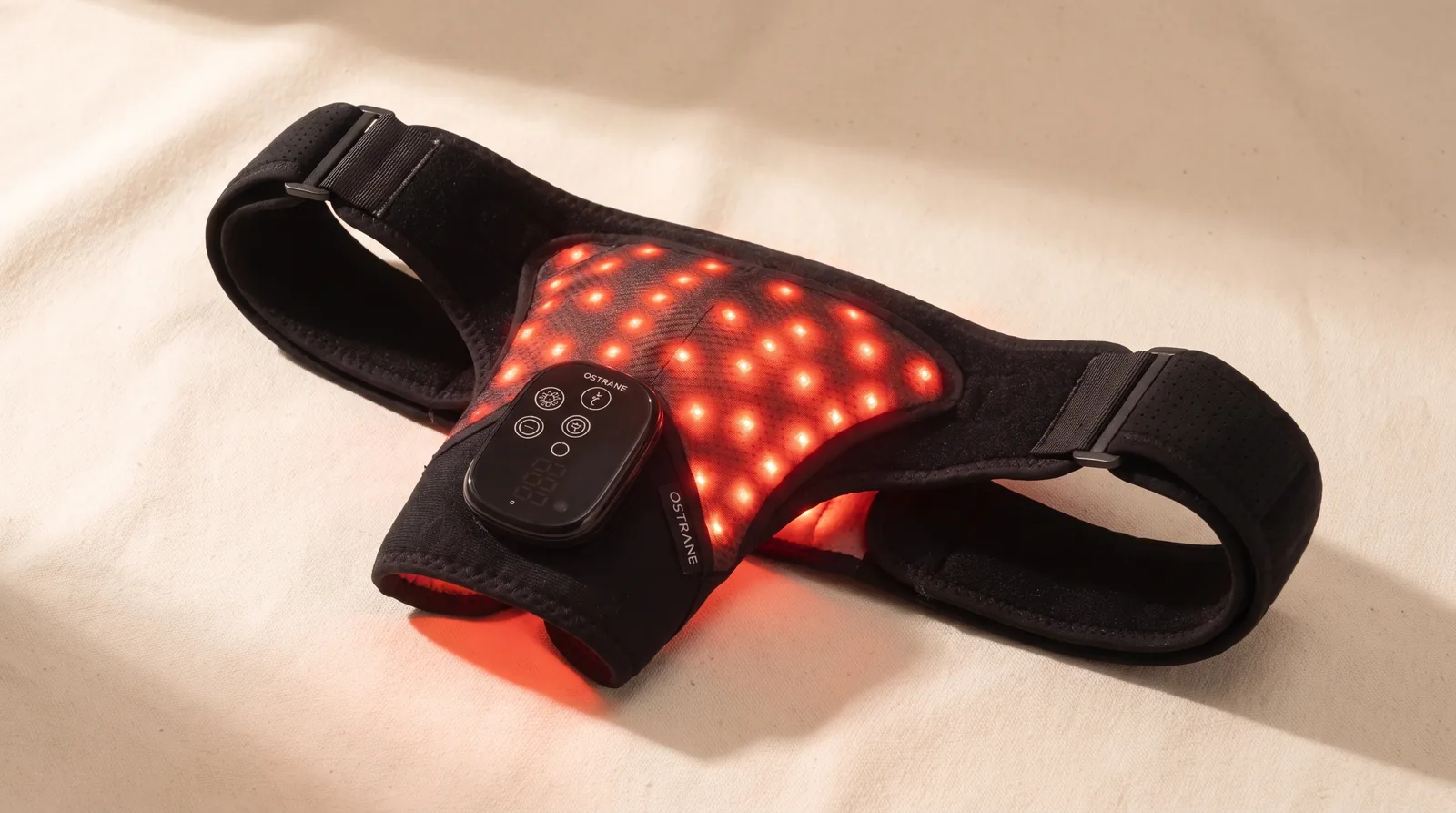
It is a wrap that sits over the shoulder and the top of the upper arm, held by a strap that runs under the opposite arm. You put it on, press one button, and read or watch something for fifteen minutes.
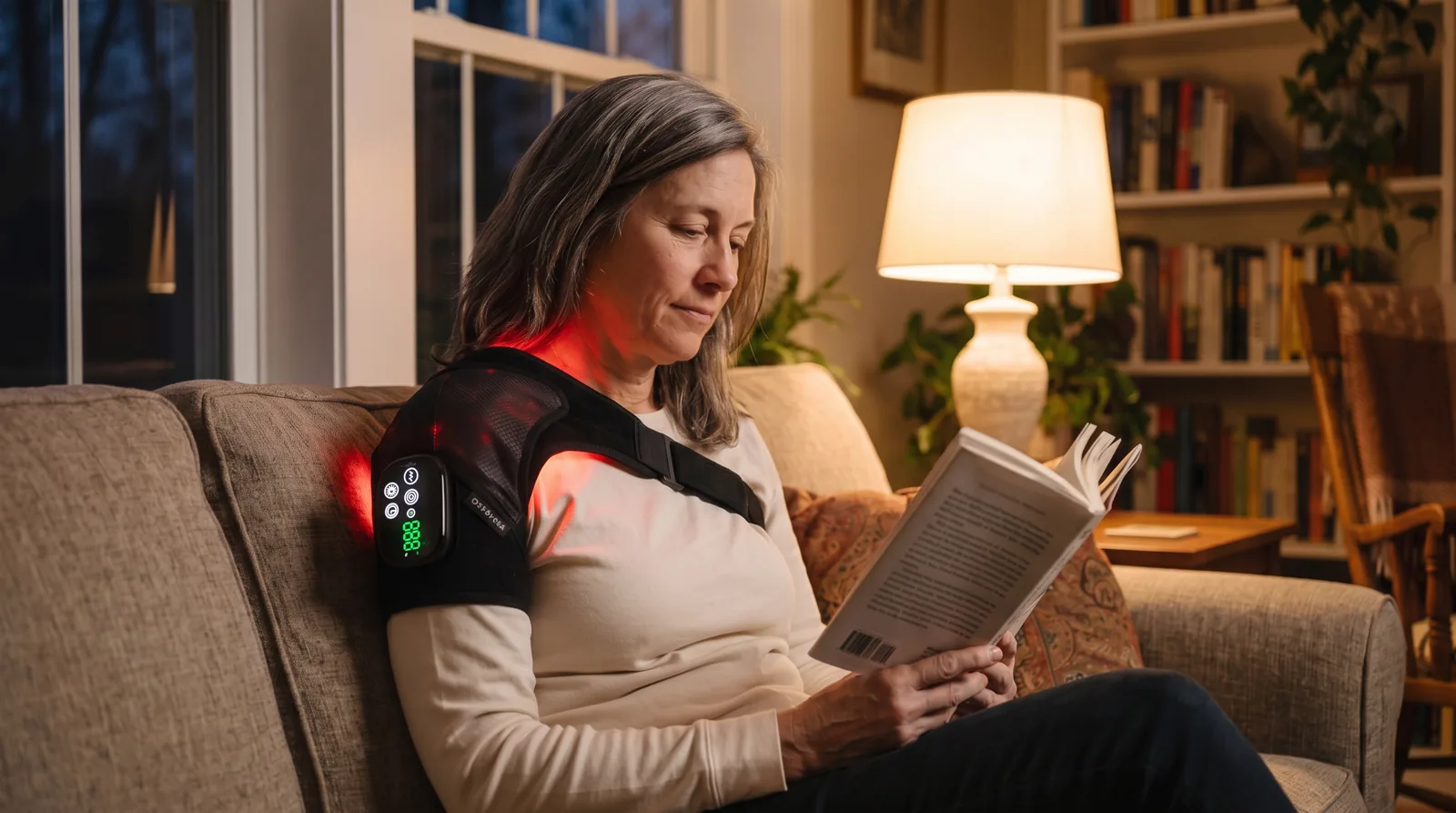
It is cordless. There is a five-thousand-milliamp-hour battery inside, so nothing is plugged into the wall and nothing runs across the bed. That matters more than it sounds like it does, because the hour you most want it is the hour you are least willing to get up and hunt for an outlet.
Inside: 660 nanometre red and 850 nanometre near-infrared, the two wavelengths from the trials. Gentle warmth underneath them. A vibration setting if you want it, off if you do not. And a timer that shuts the unit off on its own, so falling asleep in it is fine.
How you actually use it
Charge it once. It lasts several sessions.
USB. Plug it in the first evening while you read. You will not be doing this every day.
Fifteen minutes, once a day.
Evening is what most women settle into, because it is the one time of day you are already sitting down. Put it on, press the button, do not think about it again.
Week one, expect very little.
Warmth. Possibly a mild tingling. If somebody promises you a transformation in three days, close their page.
Weeks two to four is where the trials measured.
The four-week mark is where the reviewed trial recorded its pain difference. That is the first honest checkpoint.
Eight weeks was the full protocol.
Both trials on this page ran eight weeks. Your 180 nights are more than double that, on purpose.
What to expect, and when
The trials ran eight weeks. You get 180 nights.
The break in the line is deliberate. Weeks 1 to 8 are the trial protocol. Night 180 is our promise, not theirs. Trial protocol: PMID 18341417 — eight weeks, first measurement at four. Our trial period is more than three times longer than theirs.
- Ostrane Ember wrap — 660 nm + 850 nm
- 5,000 mAh battery — cordless, no cable across the bed
- Auto shut-off timer — safe to fall asleep in
- Three warmth levels · vibration optional
- One size, adjustable strap
- Free shipping inside the United States
- 2-year warranty against defects
- 180 nights to decide
today — left in stock
Ordered today, it leaves tomorrow. Your 180 nights start the day it arrives.
What it works out at
And a single year is the short version of this. The reference gives one to three, and the recovery phase alone runs twelve to forty-two months.
Now add up what the last year has already cost you. The appointments. The sessions you drove to twelve times. The gels, the heat pads, the pills that got you through the night. The nights themselves. Put a number on that, and then look at this one again.
Why 180 nights and not 30
Thirty days is what a company offers when it wants you past the return window before you know. The trials on this page ran eight weeks, with function still measurable at four months. So we give you longer than the studies ran. If it is not doing anything for you, email us and we will take care of it.
What they wrote to us afterwards
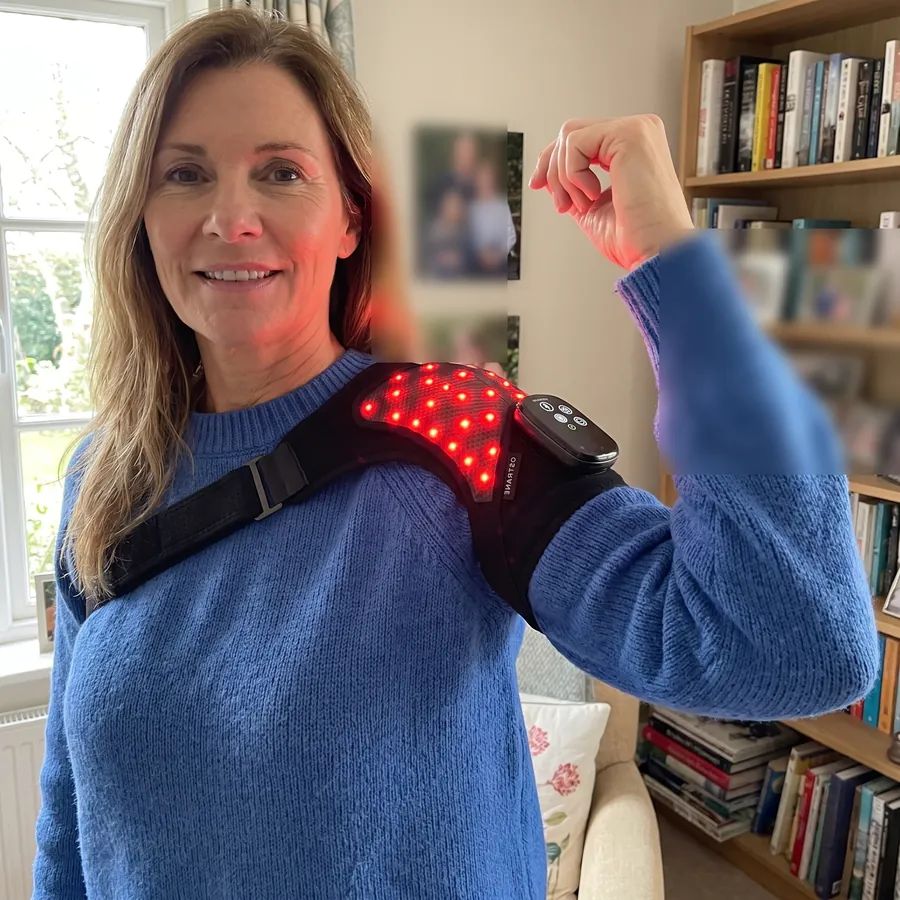
“12 physio sessions, one cortisone shot, and a drawer full of heat pads. I bought this expecting nothing. I am at week 9 and I am still using it.”
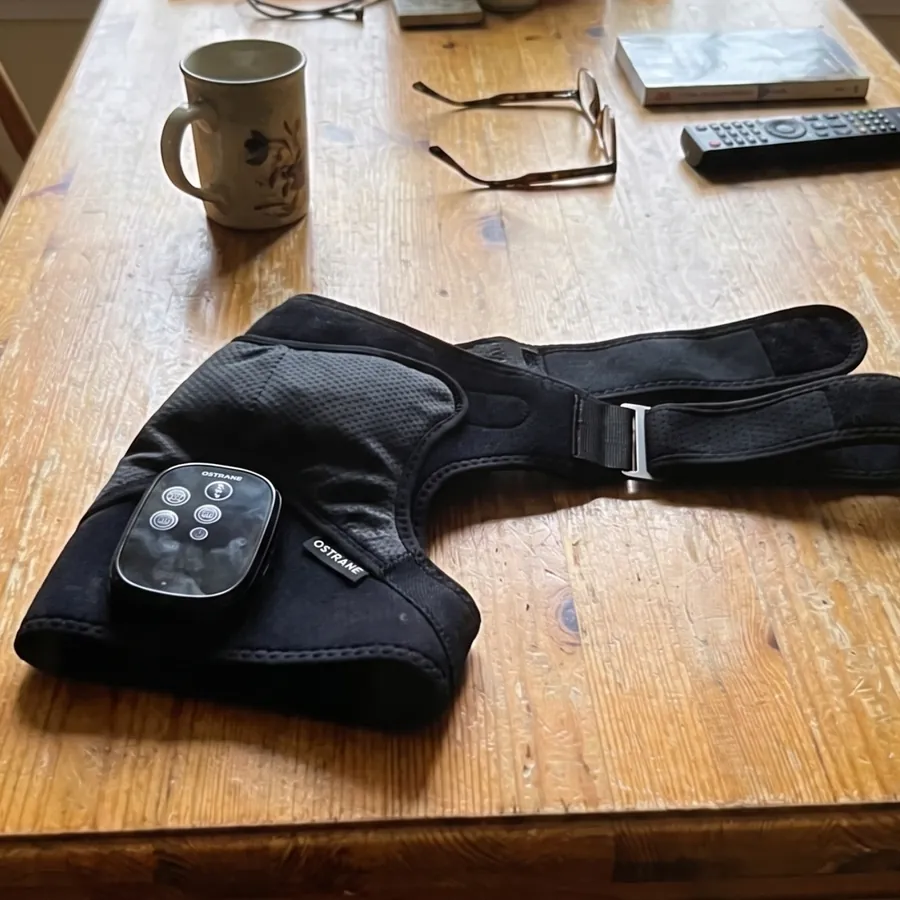
“I use while sitting in the chair, with the news on. Press the button once and forget about it. That is honestly the whole thing.”
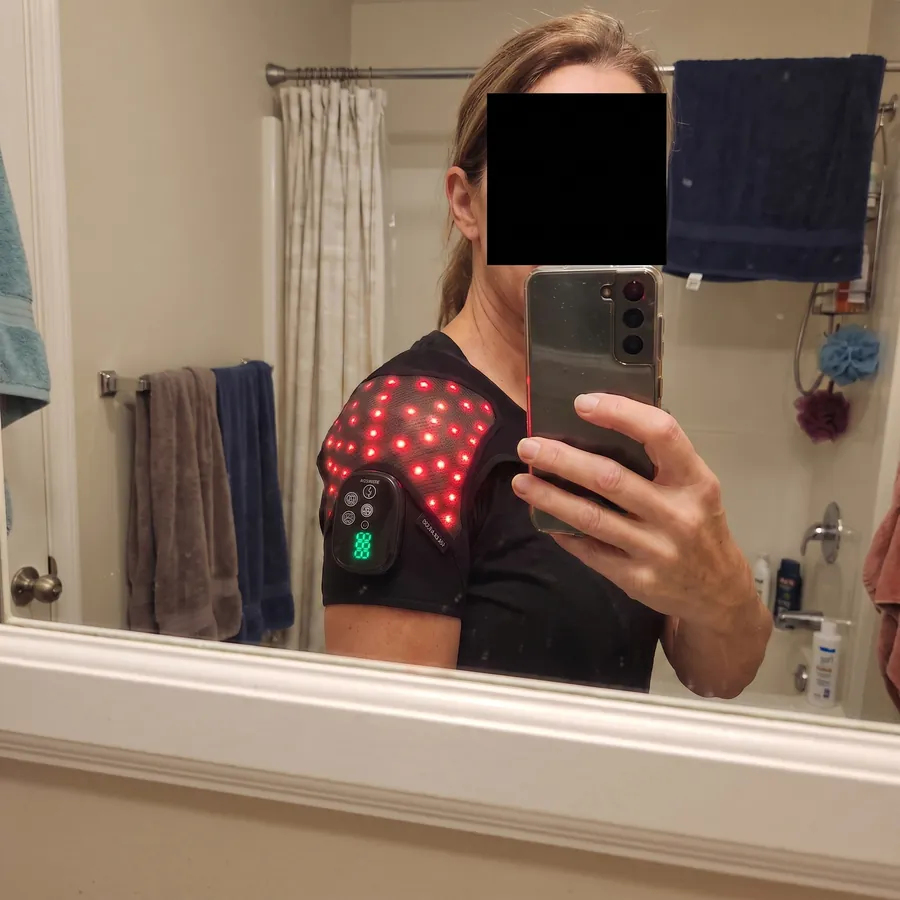
“It is heavier than I expected, in a good way. The strap actually stays where you put it. For what it cost I was braced for something flimsy.”
 GET MINE —
 180 nights to decide · free US shipping · 2-year warranty
Before you order
How long before I notice anything?
The trials measured at four weeks and again at eight. A lot of people feel the nights change first — before the arm moves further, the sleep comes back. Give it the run the trials gave it, and you still have 180 nights after that to decide.
Can I use it while I sleep?
You can fall asleep in it. The timer shuts the unit off on its own, so there is nothing to watch and nothing to switch off. Fifteen minutes is the session the protocol is built around.
I have already had a cortisone injection. Does that rule me out?
The opposite. In the two-year follow-up study on this page, every single patient had already failed physiotherapy and anti-inflammatory medication before they started. That is who this was tested on. If you have been through the usual list and it did nothing, you are exactly the person these trials were run with.
Is this the same as the machine in the physio room?
Same two wavelengths. 660 nm and 850 nm — the ones the trials ran at, the ones the clinic units use. The difference is that this one is yours, it sits on your shoulder at eleven at night, and there is no waiting room and no appointment between you and it.
What if it does not work for me?
Then you have lost nothing. Email us at info@ostrane.com within 180 nights and we will take care of it. That is more than three times as long as either trial ran.
Two ways this goes.
In the first one, you close this page and tonight is the same as last night. The shoulder does not care that you thought about it. Somewhere between one and three years from now it will probably ease, and you will have spent that time the way you were told to — waiting.
You will count it in Christmases. You will say no to a few more things. You will get used to the chair in the corner, and to the person who sleeps in it.
In the second one, you spend fifteen minutes an evening on the two wavelengths behind the only treatment Cochrane graded above very low. And you take 180 nights to find out whether it does anything for you — which is longer than either trial ran.
You have already waited longer than that. The difference is that this time you would be waiting on purpose.
The twelve to forty-two months do not pause while you decide. Today is today. Order now and it leaves tomorrow, and the 180 nights start the day it lands on your doorstep — not the day you first thought about it. Every week this sits in a tab is a week off the front of that, and a week added to the end.
left in stock as of today. When they are gone the next batch is six to eight weeks out.
GET MINE —180 nights to decide · free US shipping · 2-year warranty